
What Goes Through Cadence.CI
Cadence.CI coordinates the machines of a run and keeps its records. The work itself and the data your steps exchange stay on your side: on the machine where you launch the pipeline and on the instances in your cloud account. So do your secrets, unless you choose to store them on Cadence.CI.
Your side
Engine you launch
On your laptop or in a CI job.
Machines in your cloud account
One per step, started and stopped by Cadence.CI.
Requests machines; reports status, logs, debug events and the program
Report status, logs and debug events
Starts and stops them through your provider's API
Cadence.CI
Coordinates the machines and keeps the run records, where secrets appear only by name and type.
What Cadence.CI Receives
Section titled “What Cadence.CI Receives”| Data | Sent when | Visible to |
|---|---|---|
| Run status: requested, started, finished, result | Every reported run | Organization members |
Entrypoint and parameter values. A Secret parameter appears only as its name and type, never its value |
Every reported run | Organization members |
| Logs, with any secret value masked | Every reported run, in chunks while it runs | Organization members |
| Debug events, which never contain secret values, at any level | Every reported run, at the basic level unless set otherwise with --debug-level |
Organization members |
| Program: the Mélodium pipeline that ran, not your application code | Every reported run | Organization members |
| Resources requested: CPU, memory, storage, architecture, container image names | Every reported run | Organization members |
| Instances started: provider, type, zone, IP addresses | Runs on a connected cloud account | Organization members |
| Cloud account credentials | When you connect a cloud account | Encrypted as a platform secret of the organization, used by Cadence.CI to start and stop instances, never shown again |
| Secrets you store on Cadence.CI, encrypted | When a member or a run stores one | Read by the runs the rules allow, never shown again |
| Caches and run artifacts: names, cache scopes, versions, sizes, digests and media types | When a run saves or pushes one | Organization members; public artifacts, to anyone |
| The bytes of caches and artifacts, without storage of your own | When a run saves or pushes one | Kept on Cadence.CI storage, read through links signed for each transfer |
| Storage keys of your own buckets | When an administrator adds a bucket | Kept as a platform secret, never shown again |
On the open-source plan, runs, their logs and their program are public; debug events stay visible to members only.
Retention follows your plan: 120 days without a plan, five years on Basic and on the open-source plan, ten years on Pro, custom on Enterprise.
Secrets
Section titled “Secrets”Credentials are values typed Secret. You give them as locators, never as values:
env:MELODIUM_SECRET_<NAME>reads an environment variable whose name starts withMELODIUM_SECRET_;file:<path>reads a file;vault:<path>#<field>reads a Vault or OpenBao server;api:<name>reads a secret stored on Cadence.CI, on Cadence.CI workers.
The engine that needs a secret resolves it on its own machine. For secrets kept on your side, Cadence.CI only ever learns that a secret exists, by its name and type: in the parameters, the program and the debug events. Secrets stored on Cadence.CI are encrypted, nobody reads them back, and only the runs the rules allow receive them. Logs mask any secret value a step might print. The one exception is a value your own program turns back into plain data with reveal; secrets read from environment variables, files and Cadence.CI can never be revealed that way.
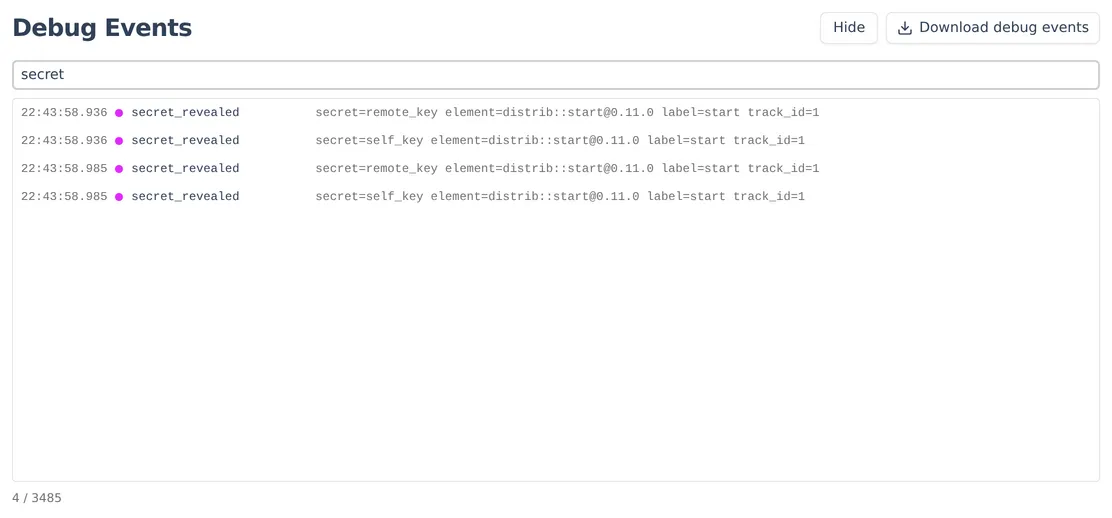
The secret audit in the debug events, above, records which element used which secret, and nothing more: here, the two keys that secure the connection to each step’s machine.
What Stays on Your Side
Section titled “What Stays on Your Side”- Data between steps. Files and values streamed from one step to another go directly between the engines. Cadence.CI gives the engine a runner’s address; it does not relay the traffic.
- Secret values. Those located with
env:,file:orvault:are resolved where they are used, never sent to Cadence.CI. - Caches and artifacts, with storage of your own. Their bytes are kept in your bucket, and workers and browsers transfer them straight to it. Cadence.CI handles bytes in two cases only: it copies artifacts between your buckets for replication, through memory, and it serves the HTML documents of renders.
- Your cloud account. Instances, images and network stay in your account. Cadence.CI acts through your provider’s API, with the permissions you grant when you connect the account.
Going Further
Section titled “Going Further”- Where It Runs: the options for launching the engine and running the steps.
- Secrets: keeping them on your side or storing them on Cadence.CI.
- Storage: where caches and artifacts are kept.
- Integration with Cloud Providers.